



 2026, February. Vacation organizing is shifting. Customers are no longer clicking through ten azure boxes while typing concerns into Google.
connections. They are requesting a vacation program from ChatGPT, Gemini, Perplexity, and Copilot, and receiving a total response.
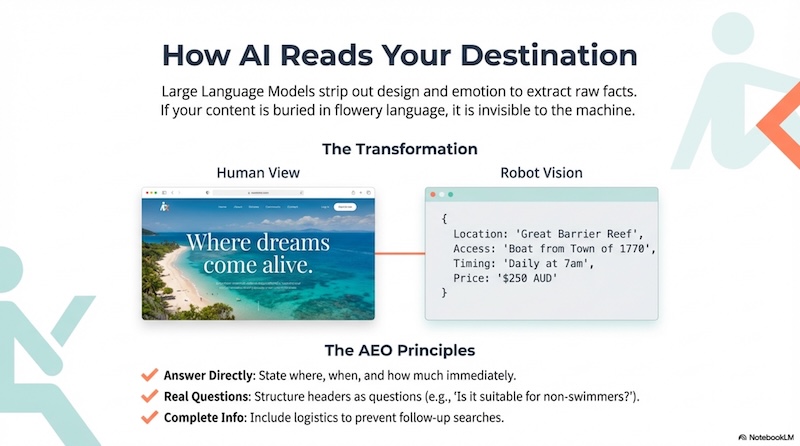
without actually visiting your site. This raises serious, practical questions for DMOs and hospitality operators. Below are 15 of them, answered. Larger language models don’t use the same technique to navigate your site as people users do. They don’t love your warrior image or observe your navigation. They read your text, remove layout, and attempt to extract the information from it. What AI tools look for: Clear, factual statements (” The Great Barrier Reef is available from the Town of 1770 via Lady Musgrave
arranged headings that indicate topic hierarchy ( H1 = destination, H2 = experience category, H3 = specific ) are provided.
operator ) Consistent naming across pages ( if you call it” Agnes Water” on one page and” the Discovery Coast” on another,
What confounds AI tools: Emotive copy with no factual anchors (” Where the reef meets the rainforest and dreams come alive” ) PDFs, image-only content, and JavaScript-rendered pages that crawlers can’t read;
begins. From the first sentence, the AI is informed. The man gets the personal link from the remainder. Traditional SEO optimized for ranking Certification optimises for being the response. What if I would for three days during the Whitsundays, asks the AI associate. The AI doesn’t provide a list of links. It builds an plan. Your intention is to be the source or controller it refers to. Certification principles for commerce: Answer the question directly. The second paragraph of a snorkeling site should include the words where, when, how much, and how much. Certainly” Discover the secret of the marine world “.Use the questions customers actually ask. ” Is the coast suitable for the coral?” is a question that should be addressed.
non-swimmers”?,” Can I do a day trip from Bundaberg” ?Provide complete information. Artificial favors sources that provide answers to follow-up inquiries without the need for additional research. Include logistics, prices, annual notes, and convenience on every experience page. The Associate winners are the ones that facilitate the AI’s work. If your articles is clear, full and well-structured, the AI has no reason to look elsewhere. The completeness and accuracy of the Google Business Profile is based on a number of factors, including: Presence on trusted tourism websites ( destination site, state tourism system, ATDW), completeness and accuracy of the Google Business Profile, and structure and structure premium on the operator’s own website. Most users don’t realize their Google Business Profile is their most
a significant electronic resource. Really. But not in the way that most people believe. Schema premium doesn’t immediately make AI advise you. It makes your information machine-readable, enabling AI to collect details from data sources without making guesses. Priority schema types for tourism: TouristAttraction for experiences and points of interestLocalBusiness for operators ( with opening Hours, priceRange, address ) Event for festivals, markets, seasonal activities ( with dates ) FAQPage for common visitor questions ( A I tools love this format ) BreadcrumbList to help AI understand your site hierarchy The consistency rule: Schema markup is only useful if it matches what’s on the page, what’s on your Google
Business Profile, as well as what’s on ATDW. If your site says you shut at 5pm, your GBP says 6pm, and ATDW says 4pm, the AI perhaps give up and not suggest you at all. Your site is not eroding. Its function is changing. It is changing from the main finding route to one that is more important.
the authoritative source that AI resources research. Although the visitor may never see your website, LLMs ( Large Language Models ) like ChatGPT and others did. And it used your information to advise your destination. The new functions on the Artificial training facility’s website. Your website is where Artificial devices learn about your target. Every website serves as training.
report. Supply of validation. When AI equipment cross-reference knowledge, your web is the authoritative source for
your area. Conversion node. Customers who use AI referrals tend to travel a further down the funnel. They’ve now
opted to come. Your site needs to convert, no influence. Users ‘ content hub. Your technician listings pull into AI recommendations. Keep them up to date. New success metrics: AI citation rate ( how often AI tools reference your content ) Answer accuracy ( are AI tools getting your destination right? ) Reduce using total traffic as your main KPI and instead use distributed reach ( website + embed widgets + AI citations = lower intent ). Determine influence instead. This is the one-million-dollar query. AI tools now favour OTAs because OTAs have much structured information, more evaluations, and more constant information. What users can do: Create a booking site. If yours says” visit to book” or “enquire today”, the AI doesn’t suggest a strong reservation. Real-time presence and online reservations are required. Use reservation model html. Put offers and a potentialAction structure to let AI equipment know this is a bookable product. Keep charges on your site. If the price is only accessible within a arranging widget that the crawler can’t learn, AI tools doesn’t recommend it. Build assessment level on Google. The more testimonials on your GBP, the more likely AI resources will use your main listing rather than an OTA formation. Claim and optimise ATDW. The standard tourism collection of Australia is fed into Google and AI equipment. Inadequate ATDW = visible to the habitat. Yes, but not as sociable businesses ‘ expectations would. AI tools are increasingly ingesting public social media content, particularly: TikTok and YouTube for “hidden gem” and” things to do” recommendationsInstagram for visual verification ( A I can now interpret images and associate them with locations ) Reddit for authentic, unfiltered travel advice ( a major source for AI travel recommendations ) What this means for your social strategy: Use location tags and full place names in captions, not just hashtags. ” Snorkeling at Lady Musgrave Island,
Town of 1770″ is more useful to AI than”# 1770life #reefdays” Include practical information in captions. Sales, period, and annual availability. The expressive comment with
AI can’t see the truth. Create list-style material that AI tools is parse:” 5 complimentary things to do in Agnes Water”Encourage technicians to do the same. Operator-generated material and its visitors from users are a part of the overall experience.
Artificial training data share. You are free to make your own decision. You part. The” Facts First, Story Second” structure is that Lady Musgrave Island is a coral cay on the southern Great Barrier Reef that can be reached by boat from the town of 1770. Day trips run regularly from October to May, departing at 7am. snorkeling, glass-bottom boat tours, and beach excursions are included. Suitable for non-swimmers ( pontoon available ). starting at$ 250 per adult. The time you slip beneath the surface, the coast unfolds like a living fabric. Turbulence glides past with a grin.
languid elegance that makes you forget you have a return ship to catch…A I equipment extract from the scientific result. Humans take the narrative literally. Both people are served. Test: Do an AI still be able to recall the experience if you deleted all of your narrative and only the facts?
is, where it is, when it operates, and how much it costs? Add more details if not already provided. Finish your Google Business Profile. fully. Not merely name, address, mobile. Fill out all the necessary fields: categories, characteristics ( wheelchair accessible, outdoor seating, pet-friendly ), business description, products/services. Stay opening hours present. reply to each evaluation. Include photos monthly. In the Artificial period, this digital asset is your most valuable. Set actual responses on your site. Create a true FAQ section that responds to the inquiries your customers make. No marketing fluff. May I bring my dog, please? “”, Is there color? What occurs when it rains? “”, How far is the vehicle area from the gate? Your responses become the AI’s responses because these are the questions that AI tools are asked. Be consistent everyday. Your site, Google Business Profile, ATDW, TripAdvisor, Facebook, and any other list may contain your company name, address, telephone number, starting time, and costs exactly as they appear on your site. Inconsistency is the number one cause AI
equipment bypasses companies. If the AI isn’t convinced which information is correct, it didn’t advise you. The most crucial information source for AI-driven travel advice is Google Business Profiles. Whole
quit. Google’s own AI products ( Gemini, Search Generative Experience ) pull directly from GBP data. Another AI resources
( ChatGPT, Perplexity, Copilot ) also scrape or reference Google’s knowledge graph, which is built primarily from
GBP information What matters most: Completeness — every industry filledAccuracy — hours, location, contact details all correctCategories — primary and secondary categories effectively setAttributes — accessibility, amenities, payment methodsReview volume and recency — not only sun ratingReview responses — AI tools may learn owner responsesPhotos — AI is now view images and associate them with experience quality The review content matters as much as the rating. When a reviewer describes “fabulous snorkeling, saw three turtles,”
the crew were fantastic and the lunch was surprisingly good”, the AI extracts: snorkelling quality ( high ),
wildlife ( turtles ), service ( high ), and food ( good ). These become the attributes the AI uses when
matching the visitor’s query to the experience. Substantial. One of the few reliable, objective sources of information is opinionated by AI tools is reviews. PlatformAI WeightWhyGoogle ReviewsHighestIntegrated into Google’s knowledge graph, used by all major AI tools TripAdvisorHighLong-form reviews with specific details, widely scrapedBooking.comMedium-HighVerified stay reviews, strong for accommodationFacebookMediumLess structured but large volumeInstagram comments Low-MediumGrowing, especially for dining and experiences ── ─ ─ ─ ─ ─ ─ ─ ─ ─ ─ ─ ─ ─ ─ ┼ ─ ─ ─ ─ ─ ─ ─ ─ ─ ─ ─ ─ ─ ┼ ─ ─ ─ ─ ─ ─ ─ ─ ─ ─ ─ ─ ─ ─ ── What AI extracts from reviews: Specific experiences mentioned ( activities, food quality, scenery ) Sentiment about specific aspects ( not just overall rating ) Recency signals ( recent reviews weighted higher ) Response patterns ( businesses that respond are seen as active and reliable ) Complaint patterns ( repeated complaints about the same issue = red flag ) Help operators understand that reviews are no longer just social proof for website visitors. They are training data.
for AI. A business with 500 detailed Google reviews will receive far more recommendation from AI than a business with 5, which is.
regardless of how beautiful their website is. The old funnel ( website visits, inquiries, bookings ) is malfunctioning. A visitor might plan their entire trip via
Never visit your website, ChatGPT, but still visit your location and spend money there. New measurement framework: Distributed Reach: Measure total reach across all channels: website visits + chatbot conversations + embed widget interactions+ AI
citations. AI Accuracy Score: Monthly, query AI tools about your destination. Check for factual accuracy, business coverage, and competition.
positioning. Conversion Rate: Lower visitor engagement, but higher intent. Track conversion rate per session ( should be increasing ), average booking value, and time from first visit to booking ( should be decreasing ). How did you organize your trip, according to Influence Attribution Survey respondents? ” Add AI tools as an optionTrack referrer data ( A I platforms have distinct referral signatures ) Correlate AI citation rate with visitation trends Accept that you can’t measure everything. The visitor who made reservations over the phone and made plans via ChatGPT may never be that way.
appear in your digital analytics. That’s acceptable. Measure what you can, and use proxies for the rest. The best page structure is: Factual summary paragraph, structured details ( table or list ), FAQ section ( 3 to 5 ) real questions, storytelling and imagery, schema markup throughout. Day 1:…, Day 2:… is easily parsed and combined with a structured list. AI tools confidently present outdated or fabricated information. A restaurant that shut down two years ago is given a chance.
recommended. A hiking trail is given the incorrect difficulty rating. A town gets placed in the wrong state. Regular AI audits are monitored. Monthly, query ChatGPT, Gemini, Perplexity and Copilot with your top 20 visitor questions. Log the responses, if necessary. Flag inaccuracies. Patterns of a track. Are certain businesses consistently misrepresented? This indicates where your source data is weak. Identify the root cause. AI misinformation typically comes from outdated website content, inconsistent platform data, missing information ( A I fills gaps with guesses ), or a lack of online presence. Correction:
You are unable to email ChatGPT and request a correction. But you can fix the sources: Update your website content ( A I tools re-crawl regularly ) Fix Google Business Profile dataUpdate ATDW listingsPublish a definitive, fact-rich page that becomes the authoritative sourceEnsure all platforms agree on the same facts Consider building your own AI concierge that uses verified local data. You have complete control over accuracy with this.
lets you offer a trusted alternative to generic AI tools. The destination website is changing from a brochure to a data platform. What stays: Beautiful imagery and storytelling, operator listings, event calendars, blog content. What is changed: an information architecture based on AI. Every page structured for machine reading first, human browsing second. AI concierge embedded. Visitors ask questions and get personalised answers from your own AI, grounded in verified data. real-time data layers are present. Weather, tides, events, business hours, availability. buried in static pages, rather than faced dynamically. API-first design. Your website uses one of your data to process it. Others include AI platforms, partner websites, state tourism bodies, and national platforms. everywhere structured data. Schema markup as a core part of the CMS workflow, not an afterthought. Don’t create a brochure. Build a content platform with structured data at its core. CSS is more important than design. Choose a CMS that makes it easy to maintain structured, up-to-date operator and experience data. AI will ignore a gorgeous website with outdated content. Build for multiple outputs. Your content should be fed from external AI platforms like email templates, social media, and the AI concierge. One source of truth, many channels. Invest in the FAQ section. Comprehensive, question-based content for every experience category. This format is the most frequently used by AI tools. Plan for embeddability. Your operator directory, event calendar, and chatbot should all be embeddable on your website.
partner websites. Your scope of influence ought to go beyond your own domain. Budget for maintenance, not just launch. A website that is accurate in 2028 is worth more than a stunning one that has been outdated by 2029. AI isn’t replacing destination marketing. It is removing the discovery layer. Visitors still want to visit your
region, eat at your restaurants, and go snorkeling your reefs. They’re just finding you differently. The good news is that the majority of this work is manageable, achievable, and practical. Complete Google Business
Profiles. Structured website content. consistent information Regular AI audits. Operator training. The destinations that act now will have a significant head start. Because once AI tools understand their destination,
well, that knowledge compounds. Every reliable recommendation results in more visitor reviews, which in turn results in more training data, which in turn results in more reliable recommendations. The flywheel works in your favour. However, if you start spinning, you must.